- The first randomized, controlled phase 3 study to confirm the benefit of dual-target combination therapy in patients with a broader MET amplification threshold (MET GCN≥5 or MET/CEP7 ratio≥2 by FISH).
- Significantly prolonged progression-free survival versus chemotherapy, reducing the risk of disease progression or death by 40%; OS data remain immature.
SHANGHAI, November 26, 2026— Hansoh Pharmaceutical Group Co., Ltd. (“Hansoh Pharma,” 03692.HK) today announced that the primary results from the Phase 3 HS-10241-301 study evaluating dalmelitinib-aumolertinib versus platinum-based chemotherapy_x0005_ in patients with NSCLC harboring EGFR mutations and MET amplification after progression on EGFR-TKI therapy have been published online in the Journal of Clinical Oncology (JCO; IF: 44.7).
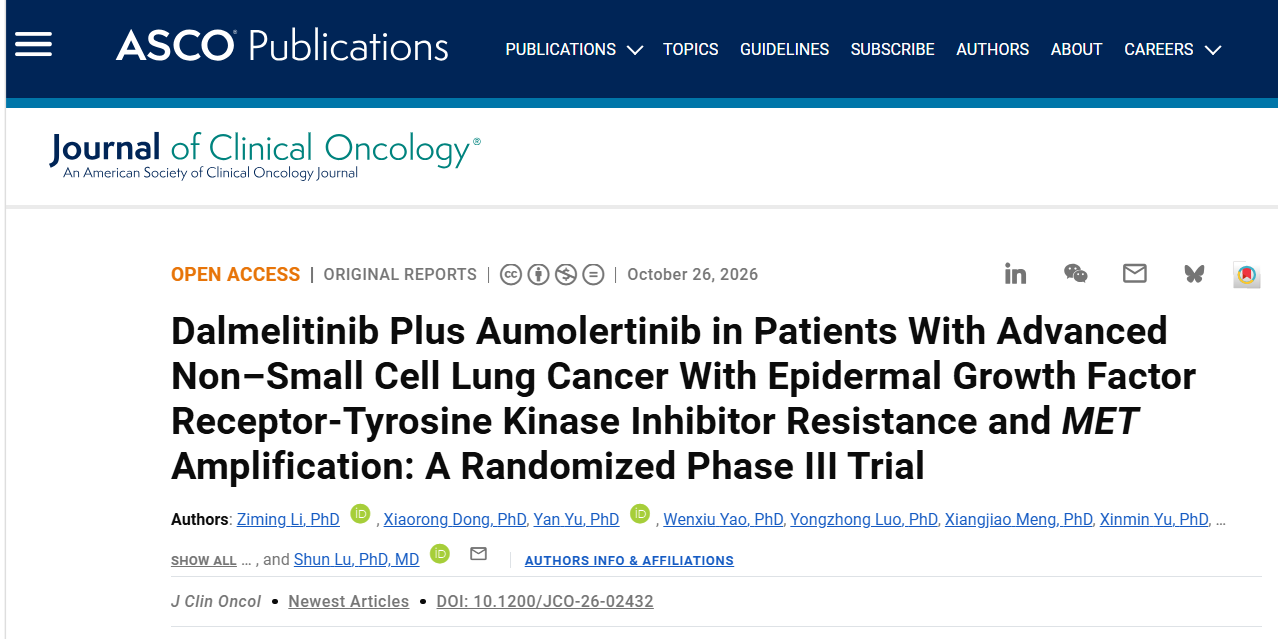
Journal of Clinical Oncology (JCO) serves its readers as the most credible and authoritative resource for disseminating significant clinical oncology research. As ASCO's flagship journal, JCO publishes cutting-edge research in cancer and is one of the most highly cited oncology journals in the world.
Dalmelitinib(HS-10241) is an oral, highly selective c-MET tyrosine kinase inhibitor (TKI) independently developed by Hansoh Pharma. Aumolertinib is the first domestically developed third-generation EGFR-TKI in China, with approved indications spanning the full treatment course for EGFR-mutated NSCLC—from early-stage to advanced disease. On February 27, 2026, the New Drug Application (NDA) for the dalmelitinib-aumolertinib was accepted by China's National Medical Products Administration (NMPA).
HS-10241-301 is a randomized, open-label phase 3 study that enrolled 314 patients with locally advanced or metastatic NSCLC harboring EGFR mutations with MET amplification after progression on EGFR-TKI therapy. Patients were randomized to receive oral dalmelitinib plus aumolertinib or platinum-based doublet chemotherapy. The primary endpoint was progression-free survival (PFS) as assessed by blinded independent central review (BICR).
As of December 10, 2025 (median follow-up: 11.2 months), the study had met its primary endpoint: Median PFS was 6.2 months versus 4.4 months (HR=0.601; p<0.001). A consistent PFS benefit was observed across all pre-specified subgroups, irrespective of prior EGFR-TKI generation and MET gene copy number (GCN≥10 vs. 5≤GCN<10).
Overall Survival (OS): OS data remain immature with an overall event rate of 22.9%. Median OS was not reached (NR) versus 19.6 months (HR=0.84), and a trend in favor of the combination. Notably, 74 patients (46.8%) in the chemotherapy arm received dalmelitinib -aumolertinib after disease progression.
Safety results:The safety profile of dalmelitinib-aumolertinib was manageable. The most common treatment-related adverse events (TRAEs) were elevated liver enzymes, mostly grade 1–2.with grade ≥3 events in 12.8% and 9.6%, respectively. Grade ≥3 events resolved to normal or baseline after management.
Dalmelitinib-aumolertinib showed a statistically significant and clinically meaningful improvement in PFS in patients with NSCLC harboring EGFR mutations and MET amplification after progression on EGFR-TKI therapy. Approximately 95% of patients enrolled in the study had previously received third-generation EGFR-TKIs, making the study population highly representative of current clinical practice in EGFR-mutated NSCLC.
Importantly, HS-10241-301 is the first randomized, controlled Phase III study to demonstrate the benefit of dual-targeted therapy in patients with MET amplification defined by broader FISH-based criteria (MET GCN ≥5 or MET/CEP7 ratio ≥2), providing high-level clinical evidence to support treatment decisions in this population. These findings further establish the clinical value of EGFR/MET dual-targeted therapy and provide important evidence to guide precision treatment strategies for patients with MET-amplified NSCLC following EGFR-TKI failure.
Previously, the study results were presented as an oral presentation in the Proffered Paper Session at the ESMO Congress 2026 [1].
About Non-small Cell Lung Cancer
Lung cancer is one of the most common and deadliest malignancies worldwide. Non-small cell lung cancer (NSCLC) accounts for approximately 85% of all lung cancer cases, and EGFR mutations occur in approximately 40–50% of NSCLC patients in China, a markedly higher rate than in Western populations[2]. Acquired resistance to EGFR-TKIs is inevitable. MET amplification is one of the most common bypass resistance mechanisms to EGFR-TKI therapy, occurring in up to 15%–25% of patients who progress after third-generation EGFR-TKI treatment, and is associated with poor prognosis [3].
For this population, effective precision treatment options remain limited, and there is an urgent clinical need for targeted combination strategies to replace conventional chemotherapy. Oral targeted combination regimens hold the promise of balancing efficacy, safety, and convenience, offering a new chemo-free treatment option for NSCLC patients with EGFR mutations and MET amplification after progression on EGFR-TKI therapy.
References
1.Lu S, Dong X, Yu Y, et al. 2615O Dalmelitinib plus aumolertinib versus platinum-based chemotherapy in advanced NSCLC patients with MET amplification post EGFR TKI: A randomized, phase 3 study
Annals of Oncology, 37, S1502-S1503.
2. Melosky B, Kambartel K, Häntschel M, et al: Worldwide Prevalence of Epidermal Growth Factor Receptor Mutations in Non-Small Cell Lung Cancer: A Meta-Analysis. Mol Diagn Ther 26:7-18, 2022.
3. Angelopoulos PA, et al. Management of MET-Driven Resistance to Osimertinib in EGFR-Mutant Non-Small Cell Lung Cancer. Genes (Basel). 2025 Jun 30;16(7):772.
About Hansoh Pharma
Statements
Forward-Looking Statements